Mandari Panga, or Wild Mandari, is located within Yasuni National Park, a UNESCO Biosphere
Reserve. It is an eco-lodge owned and operated by the local community, completely off the
grid, with only a small generator running for a few hours in the early morning and evening.
We stayed in a traditional safari tent with a high thatched roof. The walls and roof were made
from woven Irapay palm leaves. The tent sits a raised wooden platform.
Getting there was part of the experience—a two-hour car ride from Coca Airport, traveling
deeper and deeper into indigenous communities, followed by a 1.5-hour boat ride along the
river. The lodge is designed for a fully immersive, naturally sustainable experience in the
Amazon rainforest.
As it turned out, my daughter Claire and I were the only guests that week.
We didn’t speak Spanish, and aside from Bill, our guide, the staff didn’t speak English. They
often communicated in their native language, Kichwa. During our stay, beyond speaking with
Bill and exchanging the occasional “gracias,” there were almost no words between us and the
staff—just nods, smiles, and waves.
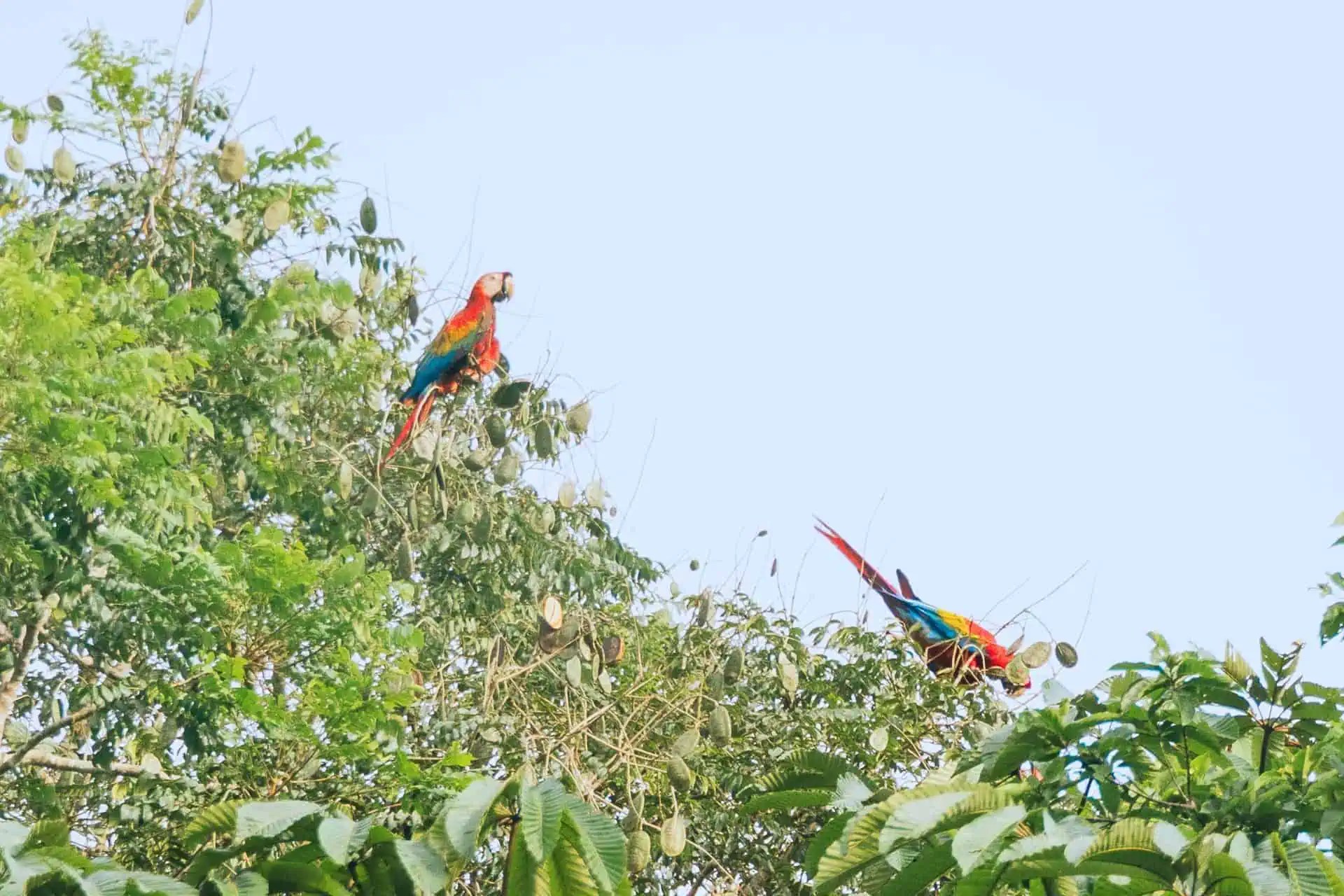
Day after day, we explored with Bill—either by boat or hiking through the jungle—searching for
birds and animals high in the trees or gliding across the sky. Toucans, kingfishers, macaws,
parrots, and so many more.
Claire, camera in hand, was always ready. I, binoculars in hand, doing my best to spot what Bill
pointed out with his green laser. When we found something, Bill would help Claire position for
the perfect shot, while the boat driver quietly adjusted his movements, watching her camera
for cues.
No words were needed—just attention. A shared understanding beyond language.
Each outing began and ended the same way: a wave in greeting, and another in gratitude for
the day. “Gracias.” It felt like enough, especially paired with a smile and a thoughtful glance.
Stripped of words, only the essence remained—and it was enough.
At the end of our stay, our boat driver brought us back to where the car was waiting. I turned
one last time to wave goodbye. He stood by the shore, smiling—a smile that reached deep into
his eyes. It stayed with me long after we left, just like the smiles from the chef and his assistant.
At the lodge, the small generator powered a few simple light bulbs and Starlink for about three
hours each evening. After that, the night returned to itself, untouched. The sounds of the jungle
filled every moment—the distant, furlong calls of toucans, the surprisingly resonant tapping of a woodpecker, the chorus of all the insects and nocturnal animals. It felt magical. Bill said there
are many more nocturnal animals in the jungle.
Each evening, bugs, moths, and even small rodents came to visit. We gently ushered them out
when we could, and learned to live with them when we couldn’t. Hurting any of them seemed,
at that moment, would for sure bring bad karma to the door step! Bill said, just yell for help if
you need any. We didn’t, because we didn’t want to look like such city girls!
Later, we set out for two nights of jungle camping. We flowed down the river in a kayak,
steered mostly by Bill. We were in the middle of their raining season, so the current carried us.
I tried to paddle in earnest, but either because of the uneven weight distribution, or the fast
river current, it seemed I often helped the boat going in circles rather than forward! Bill was
patient, and taught me how to feel the current and change sides before too late.
At one point, the staff’s motor boat passed us, with the boat driver, the chef and his assistant
on the boat, carrying all the supplies for the camp. Wind in their faces, happy and carefree,
waving and laughing as they passed. There was something so pure in that moment. It was
beautiful.
When we arrived at camp, the staff has already set a small net for fishing. That night, as dinner
was being prepared on a stove, we started a small fire. Soon the fire died out, leaving
smoldering heat and smoke. The fish caught earlier were placed on a grate above the
smoldering embers to smoke overnight – preserved against the heat and humidity.
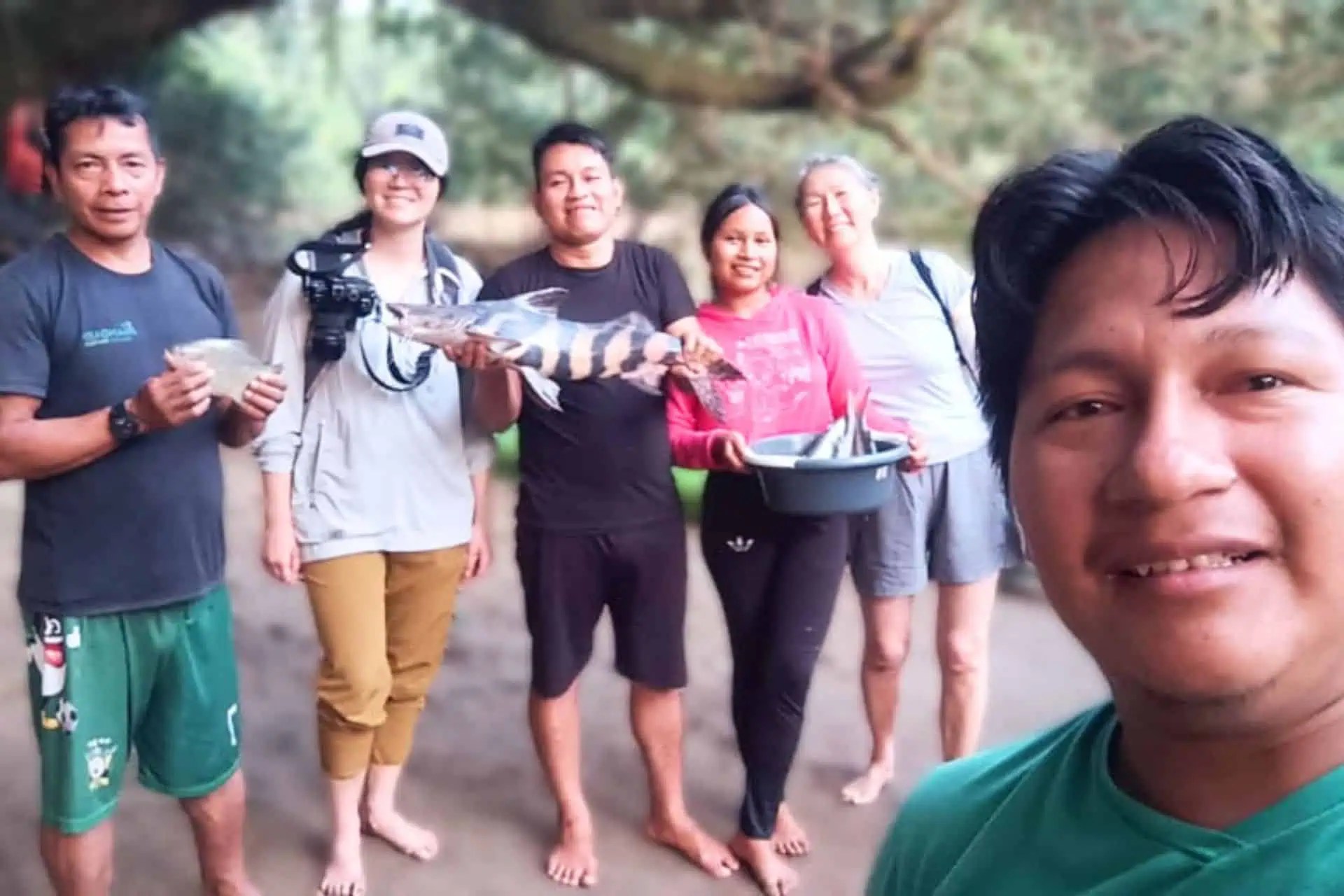
The next day, we tried fishing ourselves. Each time before we casted the line, we spat at the
bait, blew a kiss – a small ritual for blessing the bait to catch something. At the end, Claire and I
fed the fish with our baits numerous times and the staff caught quite a few cat fish and a
piranha. Three times I tried to pull my line when they bit, but I was too slow. The fish were
smart and fast!
In my heart, I wanted to give something back to the river. The staff needed fish for their
families. Nature, in its own way, handed us each what we needed.
We also visited the community that owns the lodge. The community center consisted of a large
dirt soccer field, a small schoolhouse for all elementary grades, a shared room for teachers, and
a few huts for their accommodation during the week. Each family of the community have about
50 acres of land, scattered all over the region belonged to this community. Some of the
children have to walk more than hour each day to reach the school.
Life there is simple and self-sustaining, with minimal carbon foot print to the environment.
Bill shared with us that one of the traditions in his family is that everyone gets up before sunrise
every day, around 4 or 5 a.m. They drink their traditional tea together, while the grandparents tell stories. Stories of the jungle, of danger, respect and survival, passed down through
generations.
Before a hunt, the hunters gather at the community tree, to say a prayer, asking for blessings
and safe return.
Within each family, everything is shared. Within a community, when someone needs
help—building a tent, for example—the whole community comes together until the work is
done.
Bill shared with us that ten people live in his family’s house. All the unmarried kids stay in the
family house. They have rooms for everyone, but no doors – so that the breeze can freely flow
throughout the house. No doors for any of the rooms! He said his parents live in one side of
the house and all the kids the other side. We laughed together. Indeed, we are so different.
One night, coming back from a night walk in the jungle, a long, thin snake slithered up the fence
next to us. It was not poisonous. Bill put his hand out, and with flowing motion, the snake
moved with his hand, or vice versa, almost like a dance between the hand and the snake. One
with nature, with animals. I marveled…
That same night, we cooked the fish we had caught. The chef gave us large leaves from a local
plant. We each seasoned our fish with some simple seasoning, wrapped the fish tightly in the
leave, and left it on a grate with smoldering fire. 30 minutes later, our dinner was ready –
simple and delicious!
We live in such different world.
The best I can do, I tell myself, is to practice essential living—to strip away what is unnecessary
and live as honestly and intentionally as possible. To respect nature and the resources around
me, and to waste as little as I can.
Maybe, without constant distractions—gadgets, entertainment, anxiety—I can pay closer
attention to the world around me. And maybe, through that attention, I can experience that
same kind of connection I felt at the lodge: quiet, present, and from the heart.
I don’t need many interactions. Just a few, from the heart.
That would be enough.
I miss that place—and its people.